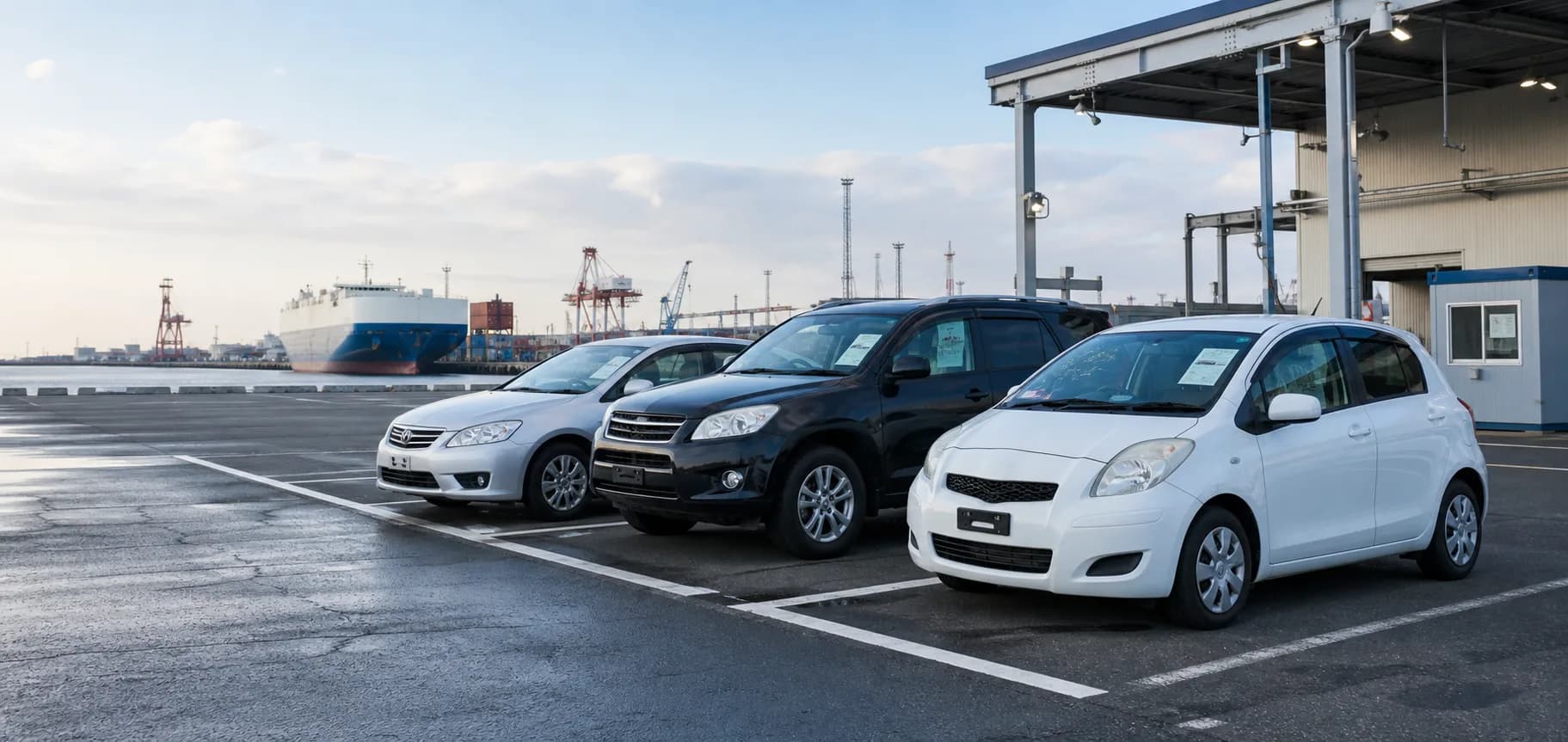
Used Japanese vehicles at an export port

End-to-end export support

From vehicle search to shipping documents.

Choose only the support you need or let one team coordinate sourcing, condition review, shipping, insurance, and export documentation.

What we handle

One export journey, four accountable stages.

Every service is organized around a buyer decision: what to buy, whether the condition is acceptable, how it should ship, and which documents must arrive with it.
01 / 04

Vehicle sourcing

Start with current stock or a specific request.

We help buyers define the make, model, year, mileage, body type, and budget, then review matching stock or sourcing opportunities in Japan.
  • Current-stock matching
  • Make and model sourcing
  • Budget and year guidance
  • Stock identity confirmation
Discuss this service
02 / 04

Condition and inspection

Decide with evidence, not assumptions.

Available auction information, mileage, chassis references, photos, videos, and additional inspection options are organized before commitment.
  • Auction-grade context
  • Condition photo review
  • Walkaround video requests
  • Independent inspection options
Discuss this service
03 / 04

International shipping

Use the route that fits the vehicle and destination.

We coordinate RoRo, full-container, or shared-container options based on port access, vehicle size, sailing availability, and buyer priorities.
  • RoRo and container options
  • Freight quotation
  • Sailing coordination
  • Marine insurance support
Discuss this service
04 / 04

Export documentation

Paperwork prepared for the vehicle and route.

Commercial and shipping documents are organized for export and destination clearance, with country-specific requirements confirmed where possible.
  • Commercial invoice
  • Export certificate
  • Bill of lading
  • Supporting shipping documents
Discuss this service

Shipping options

RoRo or container, chosen for the route.

Neither method is universally better. The right choice depends on port access, vehicle type, protection needs, and schedule.

RoRo

Efficient for running vehicles

The vehicle is driven on and off the vessel. It is often practical where regular RoRo sailings serve the destination.

  • Usually simpler loading
  • Good for individual vehicles
  • Port availability required
Container

More enclosed transport

The vehicle is secured inside a container, with full or shared-container options depending on route and availability.

  • Enclosed shipping environment
  • Useful for multiple units or parts
  • Loading costs may be higher

We quote the practical option.Final recommendations depend on the vehicle, destination port, carrier schedule, and current freight conditions.

Need a complete export plan?

Share the vehicle and destination. We will map the route.

Start a quote